
What is Market Research and How Can You Do Quantitative Market Research Even If You’re Not a Market Research Analyst?
In this article, I’ll take a closer look at a key part of the business plan. This is something that can actually help you avoid failure and support your small business growth.
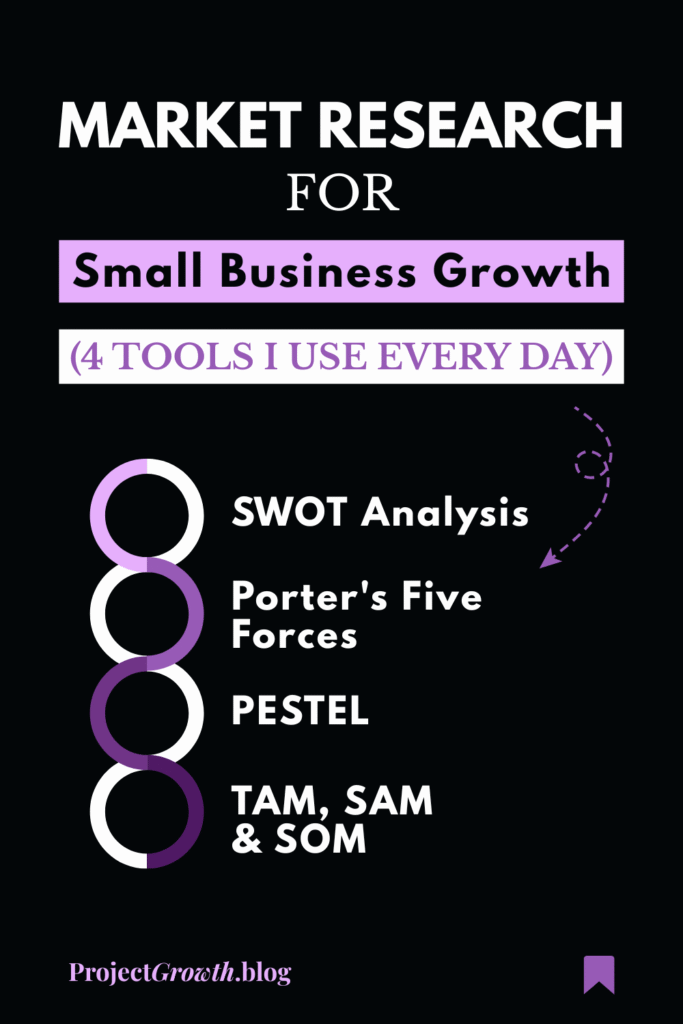
You’ll discover the four main market research tools every founder should know.
These are SWOT analysis, PESTEL analysis, Porter’s Five Forces, and building your TAM, SAM, and SOM. The best part is that you can use these tools yourself, even if you are just starting out.
This is a deep dive into my main article where I show you how to build a business plan template from scratch.
If you missed that, I recommend reading it for a clear overview. You can find it here.
💡 Free Resource for You
Once you have your market research, the real magic happens when you turn it into a business plan you can act on. I created a free pack of ChatGPT prompts that guide you through every section of a complete business plan, from market analysis to financial planning.
📥 Get your free copy here (instant access, no cost)
Quick intro about me, just so you know why I’m talking about market analysis
I’m Michele, a management engineer who studied in both Italy and Japan.

I have helped with the growth strategies of innovative startups and now work for a top consulting firm. My job is focused on strategic and digital consulting for multinationals across the world.
But this post is not about me. If you want to know more, feel free to check out my About Page.
Now let’s get into it
How to do market research
Over time I’ve figured out which market research tools really deliver the most value with the least effort.
There are many software solutions out there, but in my experience, doing market research yourself is always the best option. It helps you really understand where your project needs to go.
Let’s start with the first tool, the SWOT analysis.
SWOT Analysis: market research and internal scan
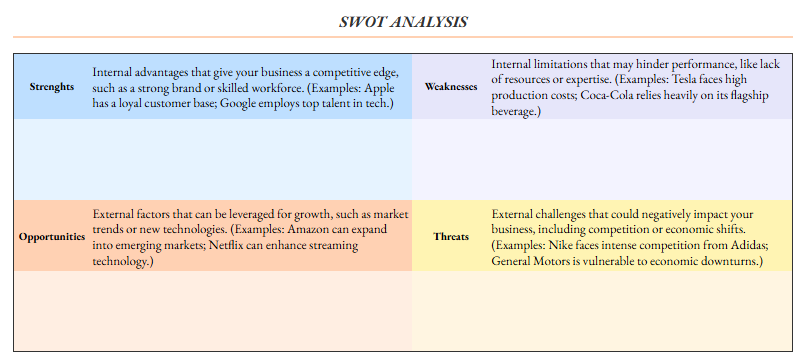
What is a SWOT analysis?
SWOT is a simple yet powerful tool that gives you a first overview of four core areas you should keep in mind as your small business grows.
You can break it into two main parts: external and internal.
External Analysis
The SWOT analysis helps you look at two external factors
Opportunities: These are outside factors you can use for growth, like new market trends or new technologies.
For example, Amazon can expand into new markets and Netflix can improve its streaming tech.
Threats: These are external challenges that might impact your business, like competition or changes in the economy.
For example, Nike deals with strong competition from Adidas and General Motors is exposed to economic downturns.
By analyzing these points, you can spot opportunities before others and also prepare your business for possible threats you find during this phase.
Internal Analysis
Now let’s scan the inside of your business
Strengths: These are your internal advantages, like a strong brand or a skilled team.
Think of Apple’s loyal customers or Google’s top tech talent.
Weaknesses: These are your internal limitations, like lack of resources or know-how.
For example, Tesla has high production costs and Coca-Cola relies heavily on its main drink.
Having an “x-ray scan” of what you can and cannot do right now will help you understand your real position and what areas you need to work on to stand out in your industry.
How to do a SWOT analysis
What I like most about SWOT is that you choose the level of detail you want.
Personally, I use it at the very start of any project. It’s almost like a structured brainstorming session.
Of course, you can spend days perfecting your SWOT analysis template. The more research you do now, the fewer mistakes you will make later.
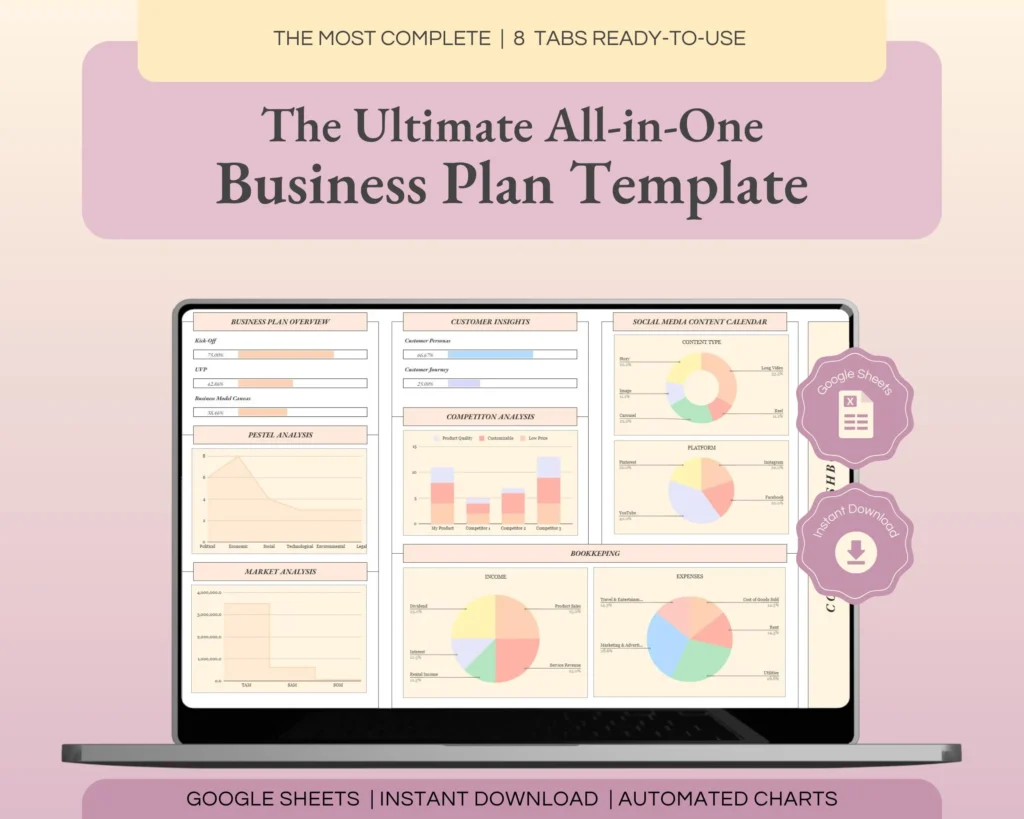
If you want to try the business plan template I created using my own experience, you can get it here (BUSINESS PLAN TEMPLATE LINK).
Let’s move on to the next market research tool
Porter’s Five Forces Analysis
I see this analysis as the next step after the SWOT. In your Porter’s Five Forces template, you’ll look at five key forces
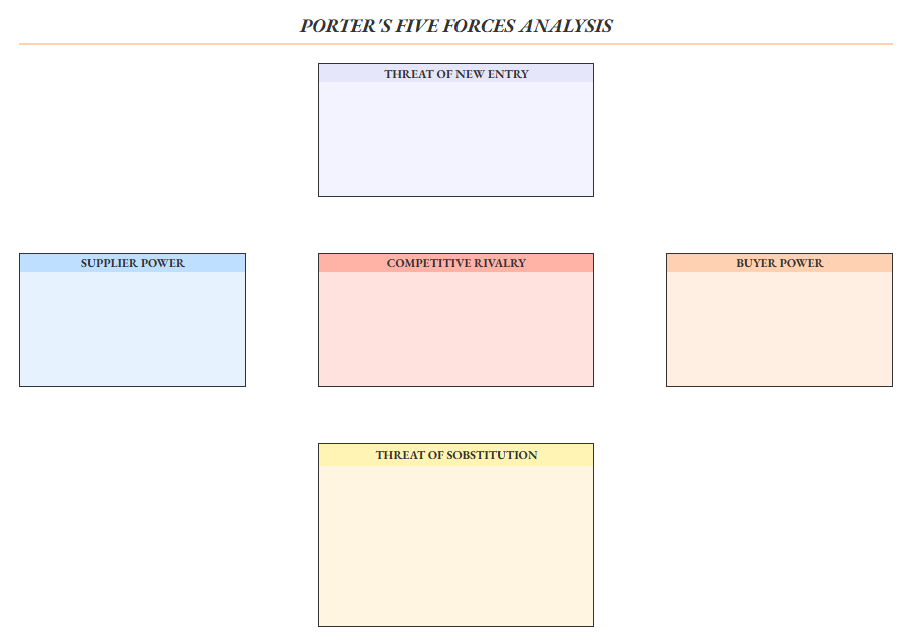
- Threat of new Entry: How easy is it for new competitors to enter your market? Low barriers can lead to more competition and a smaller market share for you. Think about the mobile app world, where new developers can easily join. Or compare with the pharmaceutical industry, where you need big investments just to start.
- Supplier Power: This is about how much influence your suppliers have over your business. If only a few suppliers control what you need, they can impact your costs and conditions. For example, chip producers hold a lot of power in electronics. In food service, you usually have many suppliers, so you can switch more easily.
- Competitive Rivalry: How strong is the direct competition in your sector? In crowded or stagnant markets, rivalry is fierce. Just look at Coca-Cola and Pepsi, or Booking.com and Airbnb.
- Buyer Power: How much power do your clients have? If there are only a few clients and they have a lot of choice, they can get better prices or easily switch to another provider. Supermarkets have a lot of power over their suppliers, while customers in a boutique have much less.
- Threat of Substitution: This is the risk that your product or service could be replaced by something else. The easier it is to switch, the higher the risk. For example, email replaced fax machines and electric cars are a threat to traditional engines.
How to use Porter’s Five Forces Analysis
The biggest benefit here is that you get to look beyond your own business and see the whole ecosystem that can impact your position in the market.
I usually use it to decide where to focus. Should I worry about new players, about buyers’ power, or about how to make my business unique so it can’t be replaced?
It’s up to you how deep you want to go. Even a basic overview can bring you a lot of strategic clarity.
PESTEL Analysis
I see the PESTEL analysis as the perfect tool to widen your view and understand all the outside factors that could affect your business over time.
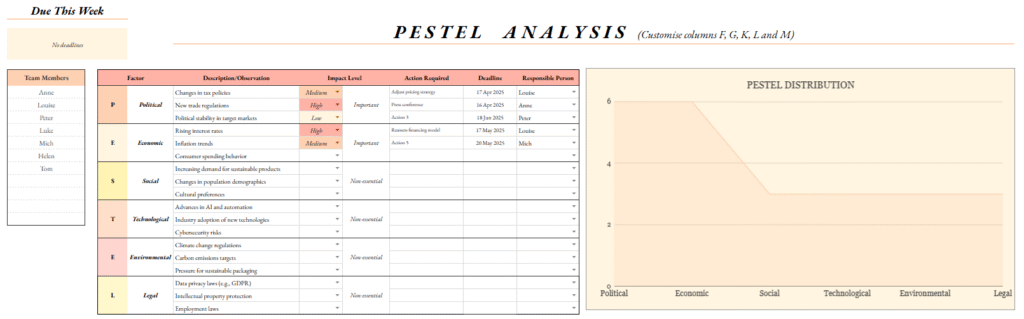
In your PESTEL template, you’ll review six big areas
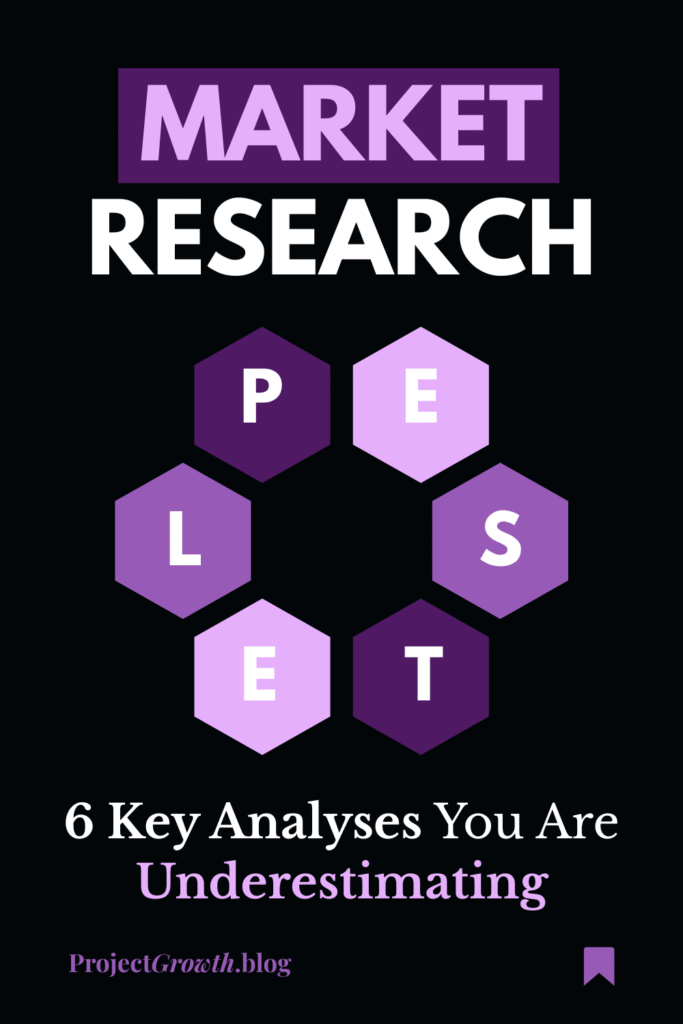
Political:
Check how government decisions, new rules, and political stability could impact your field.
For example, tax changes or new import regulations.
Economic:
Look at things like inflation, interest rates, economic growth, and unemployment. These all affect demand, costs, and profits.
For example, a recession can lower spending and currency changes can affect your material costs.
Social:
Watch for shifts in values, habits, demographics, and consumer preferences.
For example, people caring more about sustainability or an aging population.
Technological:
Think about how new tech can shake up your market, improve your processes, or create new products.
For example, artificial intelligence and the rise of e-commerce platforms.
Environmental:
Here you focus on environmental impact, green regulations, and rising interest in sustainability.
For example, emissions laws or growing demand for eco-friendly products.
Legal:
Look at the laws and rules for your sector, like safety standards, patents, or labor regulations.
For example, GDPR for data privacy or new food labeling rules.
How to use PESTEL Analysis
I recommend using the PESTEL analysis when you’re exploring new markets or making big strategic choices. It’s a great way to spot risks and opportunities you might miss if you only look inside your business.
You can go into detail or keep it simple. The important thing is to build a checklist so you never lose track of anything that matters for your business’s future.
Quick break
Sorry for the interruption, this will be quick
All these market research tools are great for building your business plan, but I always say it’s just as important to manage your business every day.
That’s why I wrote a quick article on project management, showing you the two tools I use for my projects.
They’re not hard to use.
If you want to avoid poor process management in your small business, here you can find my guide
Project Management in 5 Minutes: 2 Strong Tools That Deliver
Back to our last analysis: quantitative market research. I mentioned it at the beginning. Let’s talk about
TAM, SAM E SOM
Let’s explain what these mean
- TAM stands for Total Addressable Market
- SAM stands for Serviceable Available Market
- SOM stands for Serviceable Obtainable Market
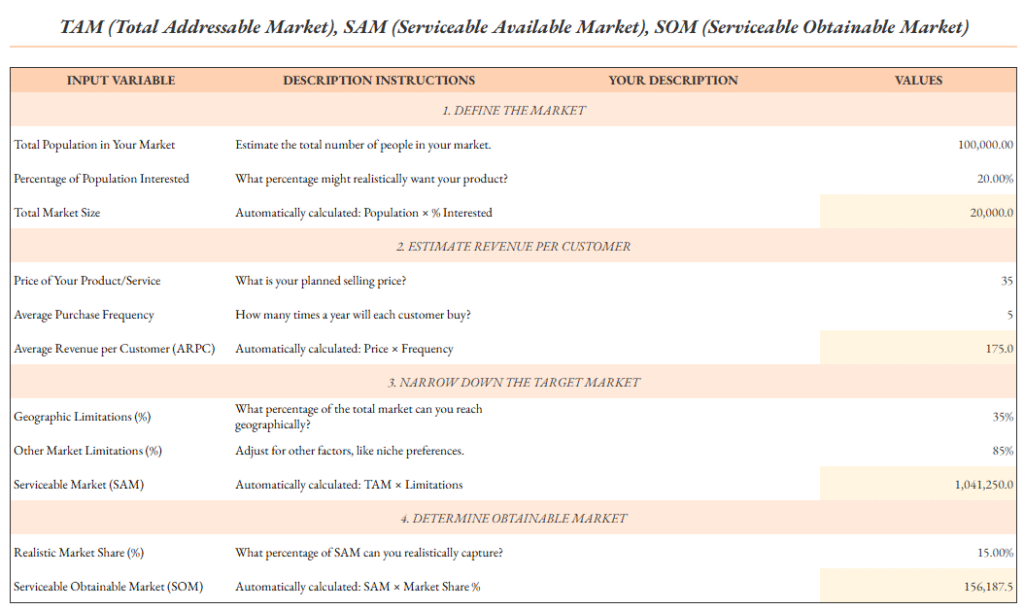
Here you’ll see a few formulas. It might sound complicated, but don’t worry.
In some tools (like the one I built) the calculations are automatic. All you need to do is fill in a few fields.
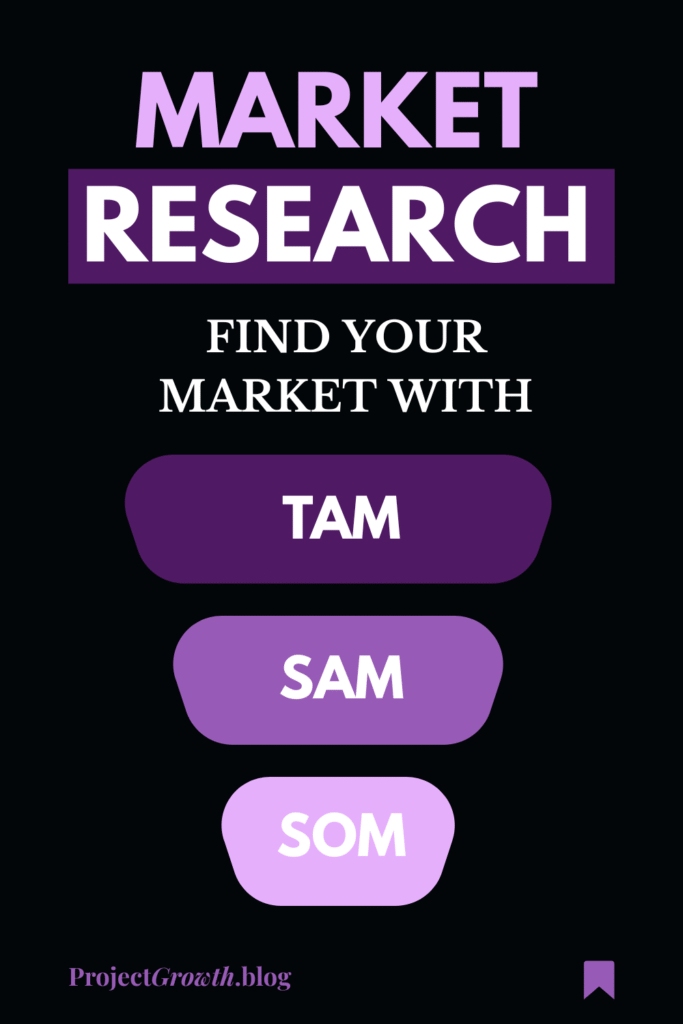
TAM: Calculating Your Total Addressable Market
Formula
TAM equals the total number of potential customers multiplied by the average annual spend per customer
Example
Imagine you sell software for restaurant management
There are 1,000,000 restaurants worldwide that could buy it
Average annual spend per restaurant is $1,200
TAM is 1,000,000 times $1,200 which equals $1,200,000,000. That’s $1.2 billion
SAM: Estimating Your Serviceable Available Market
Formula
SAM equals the number of reachable customers multiplied by the average annual spend per customer
Example
In the United States, there are about 150,000 restaurants in your target market
Average spend is still $1,200 per year
SAM is 150,000 times $1,200 which equals $180,000,000 or $180 million
SOM: Assessing Your Serviceable Obtainable Market
Formula
SOM equals the number of customers you think you can actually get, multiplied by the average annual spend per customer
Example
If your plan is to capture 10 percent of the US market in the first few years
Ten percent of 150,000 restaurants is 15,000 restaurants
Average annual spend is $1,200
SOM is 15,000 times $1,200 which equals $18,000,000 or $18 million
That’s it for the technical part, you made it!
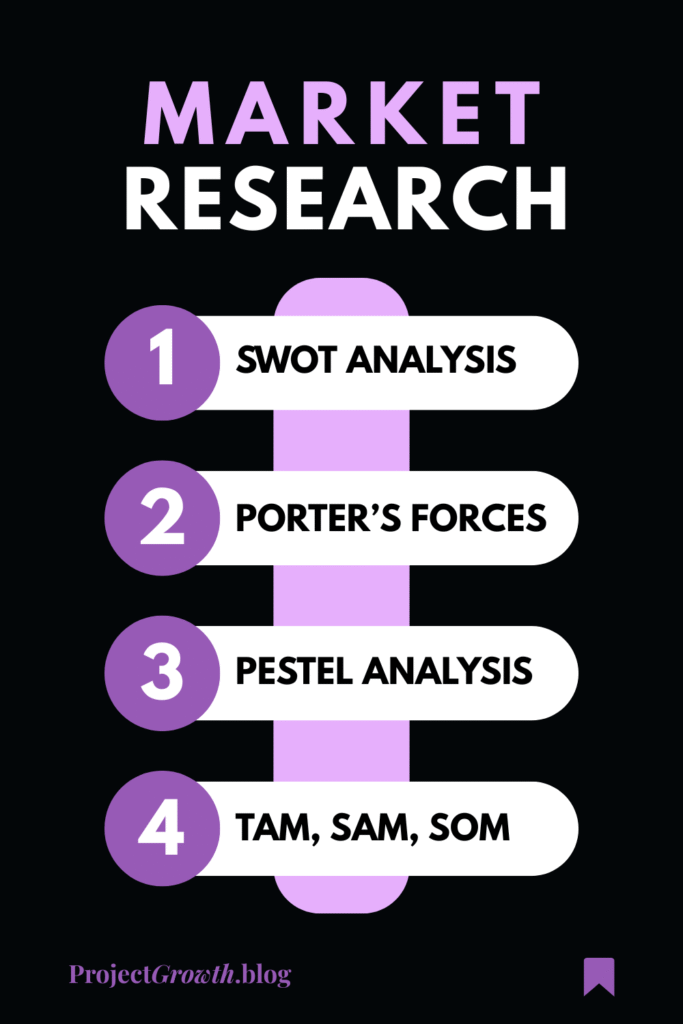
Final Takeaways
We’ve covered a lot about market analysis today
This topic is really important when it comes to building your business plan, especially for small businesses that can’t afford mistakes
If you haven’t yet, make sure to read my article on how to build your own business plan template, you can find it here (LINK).
If you want to try my custom template, just click the button below
If you are here studying how to do market research for your business plan, I’m sure you are a motivated person and you’re definitely on the right path to make your project shine.
To help you turn today’s research into an actionable plan, you can grab my free ChatGPT Business Plan Prompts. They’ll guide you step-by-step to complete every section of your plan without starting from a blank page.
Good luck. You can never have too much of it
A big hug
Michele
P.S. I often post new ideas on Pinterest whenever I publish a new article. Sometimes I share quick tips too.
If you want to stay up to date, I recommend following me there
P.P.S. If you’d like to share this article on your favorite social network, I’d really appreciate it.
Just click the icon of the social platform you prefer and you can share any of the images I’ve included here.
This is a great way to help me grow, and you can also update your business board with my content!